
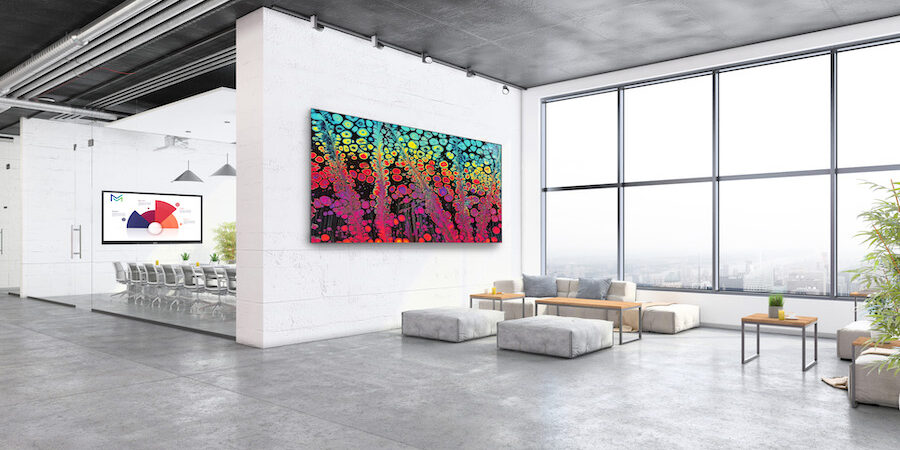
LED video walls deliver measurable business value through higher message retention, faster decision cycles, and 30–50% jumps in engagement for events and lobbies. Costs break into hardware, installation, and predictable maintenance with lifecycle planning and warranties. LEDs outperform projectors/LCDs in luminance, contrast, and uptime for high-use corporate zones LED screen display. Targeted content, centralized management, and predictive maintenance drive operational savings and revenue uplift. Scenario-based ROI and payback metrics quantify benefits and outline practical deployment choices if more detail is needed.
Why LED Video Walls Deliver Measurable Business Value
Demonstrating measurable ROI, LED video walls drive outcomes across communication, brand perception, and operational efficiency by delivering high-impact visual content that increases message retention, shortens decision cycles, and boosts engagement metrics. Organizations report 30–50% improvements in audience engagement during events and lobby interactions, with dwell times and CTA responses rising when content is tailored and dynamic. Brand impact becomes quantifiable through increased recognition scores and higher perceived professionalism in surveys after installations. Operationally, centralized content management reduces campaign rollout time by up to 60%, aligning teams and freeing staff for strategic tasks. Metrics-driven deployments link impressions to conversions, enabling managers to attribute revenue uplift and productivity gains directly to display performance, supporting scalable, freedom-oriented communication strategies.
Cost Components: Purchase, Installation, and Ongoing Maintenance
Total cost assessment for LED video walls should separate upfront purchase costs—panel quality, pixel pitch, control systems—and installation expenses such as structural support, wiring, and calibration to produce a realistic capital budget. Equally important are quantified maintenance and lifecycle variables: expected MTBF, warranty coverage, replacement module costs, and periodic service labor that drive total cost of ownership (TCO). Presenting these elements with projected cash flows and sensitivity ranges enables objective procurement decisions and ROI comparisons.
Upfront Purchase Costs
1 primary consideration in deploying an LED video wall is the upfront purchase cost, which breaks down into three measurable components: the display hardware purchase, professional installation (including structural modifications and electrical work), and initial maintenance setup (warranty extension, spare parts inventory, and baseline calibration). Decision-makers evaluate this capital expenditure against expected ROI, comparing financing options such as leases, loans, or capital leases to preserve operational freedom. Hardware quotes should reflect bulk discounts for larger projects; negotiation leverage increases with multi-site commitments. Installation bids must itemize labor, permits, and any structural reinforcement to avoid scope creep. Initial maintenance setup costs are fixed and negotiable with vendors. Clear line-item budgeting and disciplined vendor negotiations compress cycle time between decision and deployment while preserving financial flexibility.
Maintenance and Lifecycle
Balancing purchase, installation, and ongoing maintenance costs determines an LED video wall’s true lifecycle economics: initial capital outlay and installation typically account for 60–75% of first-year expenses, while recurring maintenance, spare parts, and periodic recalibration drive 20–35% of total cost of ownership over a 7–10 year service period. A disciplined maintenance strategy reduces downtime and preserves visual fidelity: scheduled calibrations, modular component swaps, and targeted spare inventories lower mean time to repair and extend useful life. Data-driven service contracts and predictive maintenance platforms cut reactive repairs by up to 40%, improving uptime and predictable budgeting. End-of-life planning—trade-in options and verified recycling programs—recovers residual value and supports corporate sustainability ambitions while freeing capital for future display upgrades.
Comparing LEDs to Projectors and LCD Arrays
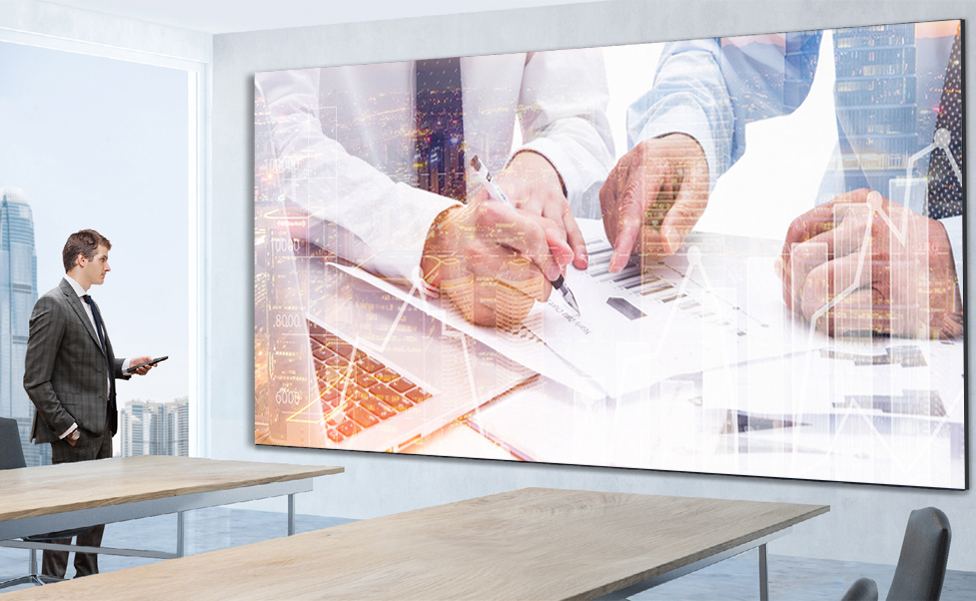
When evaluating LED video walls against projectors and LCD arrays, objective metrics—nits for brightness, lumen efficiency, and contrast ratios—determine visibility across ambient lighting conditions. Lifecycle data on component failure rates, mean time between failures, and serviceability inform maintenance and reliability expectations. A total cost comparison should combine acquisition, installation, energy consumption, and projected maintenance over a defined multi-year horizon to reveal true ROI.
Brightness and Visibility
Against varying ambient light levels, LED video walls consistently deliver higher peak luminance and better contrast than projectors and LCD arrays, making them the preferred choice for corporate spaces that require reliable visibility. Measured brightness, ambient contrast handling, and targeted glare mitigation enable clear messaging in bright atria, conference rooms, and open-plan areas. Decision-makers evaluate illuminance specs, viewing-angle retention, and content legibility under real-world conditions.
- Peak candela output exceeds typical projector lumen performance in lit rooms
- Native contrast ratios maintain image depth without ambient washout
- Wide viewing angles preserve uniformity for dispersed audiences
- Integrated brightness zoning supports adaptive power and privacy
- Glare mitigation options (matte finishes, strategic placement) reduce reflections
Quantified comparisons favor LEDs for consistent visibility and audience reach.
Maintenance and Reliability
Typically, corporate IT and facilities teams find LED video walls to offer lower ongoing maintenance overhead and higher operational uptime than projectors and LCD arrays. LED modules exhibit longer rated lifespans (50,000–100,000 hours) and minimal consumables, reducing service interventions. Fewer moving parts and sealed designs lower failure rates; mean time between failures compares favorably to lamped projectors. Predictive maintenance driven by telemetry and environmental sensors enables scheduled part replacement before visible degradation, preserving availability. Redundancy planning—modular panels, spare tiles, and hot-swappable controllers—allows partial operation during repairs, maintaining messaging continuity. LCD arrays require frequent calibration and backlight replacements, while projectors need lamp changes and alignment. For organizations valuing operational freedom, LEDs deliver predictable reliability and straightforward maintenance workflows that support continuous, autonomous use.
Total Cost Comparison
A rigorous total cost comparison accounts for initial capital outlay, installation and infrastructure, ongoing operational expenses, and end-of-life replacement or resale value. LEDs typically have higher upfront costs but deliver lower maintenance and significant energy savings versus projectors and tiled LCD arrays. Decision-makers evaluate lifecycle cash flows, total cost of ownership, and available financing options to preserve capital and flexibility.
- Upfront: LED hardware vs projector lamps and multi-panel LCD procurement
- Installation: structural support, calibration, and cabling complexity
- Operations: power consumption, lamp replacements, and service contracts
- Longevity: mean time between failures, pixel replacement, resale value
- Risk & financing: lease, PPA, or capex models to align with freedom-focused budgets
Data-driven analysis often favors LEDs for high-use corporate deployments.
Use Cases That Drive Revenue and Efficiency
Many corporate deployments of LED video walls generate measurable returns by enhancing customer engagement, improving internal communication, and accelerating sales cycles. Strategic use cases include customer-facing displays that increase dwell time and conversion rates, branded signage that elevates premium positioning, and interactive kiosks that enable self-service upselling. Internally, LED walls centralize real-time dashboards for operations, reduce meeting time through clearer visual collaboration, and support immersive training that shortens ramp-up for new hires. Data-driven deployments prioritize locations and content that maximize impressions per square foot and reduce manual communication costs. Flexible leasing and modular installs preserve budget freedom while scaling. These targeted applications drive both revenue uplift and operational efficiency without relying on speculative benefits.
Calculating ROI and Payback Periods
By quantifying upfront costs, recurring expenses, and measurable benefits, organizations can calculate ROI and payback periods for LED video walls with precision. A clear financial model compares capital expenditure to tangible returns: reduced operational costs, increased revenue from improved communications, and softer benefits like brand uplift. Energy savings and improved employee engagement should be monetized where possible. Sensitivity analysis tests assumptions and timelines.
- Initial purchase and installation costs
- Annual maintenance and energy savings estimates
- Revenue uplift from marketing and operational efficiency
- Measured gains in employee engagement and productivity
- Scenario-based payback period and ROI ranges
The result is a defensible decision metric that supports autonomy, reduces risk, and aligns investment with strategic objectives and freedom to scale.
Practical Considerations: Size, Resolution, and Location
Following ROI modeling, practical design choices—size, resolution, and placement—determine whether projected benefits are realized in situ. Decision-makers should quantify viewing distance, audience count, and message hierarchy to set pixel pitch and panel size; smaller pitches increase cost but enable closer engagement and finer brand detail. Ambient lighting assessments guide brightness and anti-glare selection to maintain contrast without overdriving energy budgets. Location planning must align with circulation patterns, sightlines, and safety codes while preserving architectural freedom. Implement content zoning to assign dynamic areas for corporate messaging, wayfinding, and analytics feeds, optimizing attention and operational value. Metrics-driven testing — A/B content, luminance logs, and dwell-time analysis — validates assumptions, enabling iterative tuning to maximize impact per square foot.
Procurement, Integration, and Vendor Selection
Several critical steps define successful procurement, integration, and vendor selection for corporate LED video walls. Decision-makers prioritize vendor consolidation to reduce complexity, lower costs, and streamline support. Systems integration planning guarantees compatibility with existing AV, network, and content-management platforms; integration timelines and resource needs must be quantified. Contract negotiation focuses on total cost of ownership, warranty terms, and flexible upgrade paths. Performance SLAs are drafted with measurable uptime, pixel-failure thresholds, and response times for on-site service. Risk assessments compare financial, technical, and operational exposures.
- Define scope, standards, and integration touchpoints
- Evaluate vendors on track record, interoperability, and support
- Negotiate contract terms including warranties and escalation paths
- Specify performance SLAs with clear metrics and penalties
- Plan phased deployment with acceptance testing and training
Frequently Asked Questions
How Do LED Walls Affect Indoor Climate Control or HVAC Loads?
LED walls increase localized heat gain and can cause minor airflow disruption around installations; strategic placement, ventilation adjustments, and targeted cooling mitigate HVAC load increases, enabling occupant comfort and systems efficiency while preserving operational freedom.
Can LED Video Walls Integrate With Building Emergency Alert Systems?
Yes. It supports integration protocols like REST, MQTT, and SIP; enables alert prioritization via API-driven rules and VLANs. Stakeholders receive configurable failover, logging, and analytics to guarantee resilient, auditable emergency communications.
What Are Cybersecurity Risks of Networked LED Video Walls?
Networked LED video walls face risks: network intrusion via weak access controls and exposed ports, firmware vulnerabilities enabling persistent compromise, supply-chain tampering, and data interception; mitigation requires segmentation, secure updates, monitoring, and strict access governance.
How Do LEDS Impact Office Acoustics or Sound Reverberation?
LED panels minimally alter room acoustics; their flat, rigid surfaces reduce acoustic diffusion and can increase reverberation. Strategic use of absorptive surrounds and angled mounts provides reverberation control, supported by measured RT60 reductions and occupant feedback.
Are There Tax Incentives or Depreciation Rules Specific to LED Walls?
Yes. The organization notes potential tax credits and accelerated depreciation; eligibility varies by jurisdiction, qualifying equipment, and energy-efficiency certifications. Financial models should quantify cashflow benefits, supporting strategic decisions that preserve operational flexibility and tax optimization.
Conclusion
Adopting LED video walls yields a quantifiable strategic advantage when evaluated against total cost, uptime, and revenue impact. With lower lifecycle costs than lamped projectors and superior visual ROI versus tiled LCDs, LEDs drive engagement in customer-facing, operational, and collaboration environments. Decision-makers should size systems to use case, model expected incremental revenue or efficiency gains, and apply payback and NPV analyses. When procurement prioritizes reliability and integration, LEDs typically pay back within predictable multi-year horizons.
…